


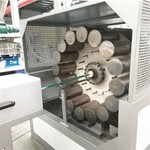
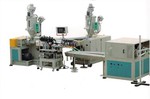
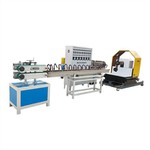
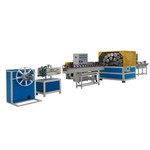
Hose Extrusion Line
What Is Hose Extrusion Line
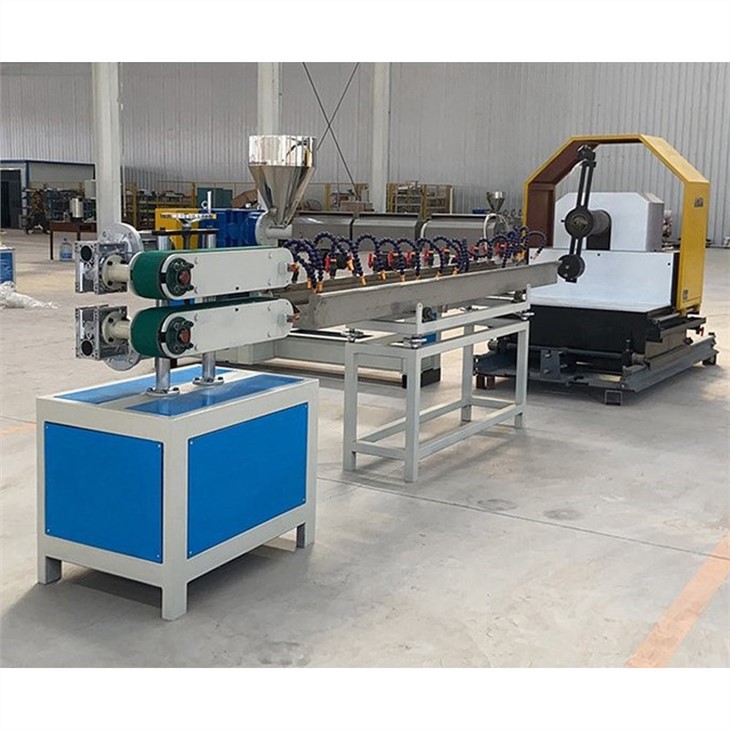
Extrusion is a process used to produce objects or materials of a specific size, shape, or profile by forcing them through a restricted opening. There are many types of extrusion processes. A hose extrusion line is a manufacturing process that creates hoses by forcing a heated material, typically rubber or plastic, through a die. This process can be used to develop hoses of various sizes and shapes. The hose extrusion process is relatively simple and can be completed in a matter of minutes.
Advantages of Hose Extrusion Line
Speed Produced
The first advantage of using a hose extrusion line is the speed at which hoses can be produced. Hose extrusion lines are designed to create hoses quickly and efficiently.
Exact Specifications
The second advantage of using a hose extrusion line is the ability to produce hoses of exact specifications. When creating hoses with a hose extrusion line, manufacturers can specify the exact dimensions and specs for the finished product. It ensures that each hose produced meets the customer’s specific requirements.
Flexibility
The third advantage of using a hose extrusion line is the ability to produce hoses with various materials. Hose extrusion lines can accommodate a wide range of materials, including rubber, plastic, metal, and even composite materials. This flexibility allows manufacturers to create hoses that meet the specific needs of their applications.


Why Choose Us
Our Factory
Founded in 2010, located in the beautiful kite capital of the world ---- Weifang. Weifang Sansen Plastic machinery Co., Ltd. is a professional plastic machinery manufacturer especially in PVC plastic hose production line.
Our Product
The company mainly produces plastic machinery, leading products are PVC fiber reinforced hose production line, PVC steel wire reinforced hose production line, Plastic bag making machine, PP-R unit, PET (PP) packing belt production line, PVC PE PP granulation unit, PVC foam hose production line and other types of plastic machinery.
Strong R&d Team
The company has strong R&D team and advanced management system, with good equipment, excellent products, perfect after-sales service to create good economic and social benefits for its customers.
Our Service
We try and respond to all concerns within 24 hours and our teams are always at your disposal in case of any emergencies.
Preparation Of Plastic Material
The hose production process begins with careful preparation of the plastic material to be used. Granular plastic material is mixed in specific proportions and formulated to create the basic structure of the hose.
Plastic Extrusion
Plastic material is shaped through plastic extrusion, the main step in the hose production line. In this process, the material is heated, melted, and passed through a special die to take on the desired hose shape. Plastic extrusion is a critical step that determines the inner and outer surfaces of the hose.
Adding Reinforcement Material
Some types of hoses include reinforcement materials to enhance durability. At this stage, materials such as textiles, wires, or special reinforcements are added to the hose that has undergone plastic extrusion. This increases the hose's durability.
Cooling And Molding
The shaped hose undergoes a cooling process to achieve the desired form and is molded. This post-extrusion step optimizes the durability and flexibility of the hose.
Cutting And Packaging
Finally, the hose is cut into the desired lengths and packaged. This stage of the hose production line ensures that the products are ready for storage and transportation.
Selecting the Right Hose Extrusion Line: A Path to Efficiency and Quality



Production Capacity And Pipe Specifications
The first step in selecting an hose extrusion line is to evaluate the production capacity and pipe specifications needed for the target applications. Factors such as pipe diameter, wall thickness, and production speed are crucial in determining the suitability of the extrusion line.
Quality Of Extrusion Machinery
The quality of the extrusion machinery is paramount in ensuring the consistent and reliable production of hdpe pipes. A reputable manufacturer with a track record of delivering high-quality extrusion lines is essential to minimize downtime and ensure long-term efficiency. The ability of the hose extrusion line to offer customization and flexibility is crucial in meeting diverse industry needs. The extrusion line should allow for adjustments in pipe dimensions, wall thickness, and co-extrusion capabilities, enabling manufacturers to produce pipes tailored to specific applications.
Technology And Automation
Modern hose extrusion lines equipped with advanced technology and automation enhance production efficiency and reduce human errors. Features such as touch-screen controls, remote monitoring, and automated processes contribute to improved productivity and consistent pipe quality. Selecting a manufacturer that offers comprehensive after-sales support and service is vital in ensuring smooth operations and minimal downtime. Responsive and reliable service ensures that any issues are addressed promptly, maximizing the extrusion line's performance and longevity. Choosing the right hose extrusion line is essential for manufacturers seeking to achieve production efficiency and high-quality hdpe pipes. By considering factors such as production capacity, extrusion machinery quality, customization, technology, and after-sales support, manufacturers can make informed decisions that align the extrusion line with their specific requirements. A well-chosen hose extrusion line ensures optimized pipe production, meeting the demands of diverse industries and contributing to the success of various applications.
Extrusion Process of Hose Extrusion Line
The profile or tube are pulled by an haul-off unit so that the line it is always in motion. Finally, depending on the flexibility of the product, a cutting or winding unit prepares the product for distribution. In the head there is much of the secret of a good product. It can be a model with porta mandril, with spiral, or with lateral feed. Each of these designs provides a different flow. The calibration bench, if we talk about pipelines, has the function of providing to the pipe a specific diameter and the circular shape that the product requires. You can do the calibration using vacuum or pressure.
For smooth pipes the most common system is the vacuum calibration. The vacuum caused on the outside of the tube allow the polymer, yet malleable thanks to the high temperature, stay in contact with the metal pipe head which has an inside diameter equal to the outer diameter specific for the product. In the case of corrugated pipes, vacuum calibration use the same principles as for the smooth tube. In the calibration of the corrugated pipe, the pressurized air penetrates through the channels practiced in the head and they inject the material in the still hot extruded tube. The difference in pressure caused, shapes the surface of the plastic pipe pushing it against the system, providing the product the required corrugation.
And then, we got to the cooling tank that eliminates the residual heat of the pipe that remains at the exit of the calibration tank. The importance of cooling, lies in the stability that acquires the plastic to not deform when passing through the haul off unit, where the tube is subject to pressures that could produce alterations in the circular shape required. By spray or immersion baths you can cool it down. The first system is used for pipes with large diameter, where production speeds are low and the spray can achieve effective cooling. In the immersion the tube passes through a water-filled container in constant cooling. Once cooled, it pass to the Haul off unit, which generates all the strength which, to put it in some way, pulls the profile or tube in order to extract it from the extrusion line.
The last step is the cutting unit, which also depends on much of the type of product that is manufactured. If we talk about pipe and the pipe is coiled, the cut is logically a little relevant work. But many tubes should be cut out of the extruder in equal lengths, either by lack of flexibility to be coiled or other considerations. When choosing the cutting system must be taken into account the diameter and wall thickness, the raw material used, the shape, quality and the length of the cut.
Cutting by guillotine is effective, but can produce slight deformations by the impact of the blade. With saw cuts the small dentures that cut the pipe cause small shavings that sometimes remain attached to the tube. To avoid the formation of these residues, it is used a mechanisms where the blades are inserted in the wall of the tube and spin at high speed, producing only a strip of shavings but preventing deformations.
What Are the Components of a Hose Extrusion Line
Extruder
Extruder is one of the important core components of a plastic pipe extrusion production line. The thermoplastic substance is forced through a screen changer or nozzle while a rotating screw creates friction and heats the substance.
Vacuum Tank
The pipe is sized but is prevented from collapsing by a vacuum tank. maintains an ideal shape while using sprayers to cool down the mold.
Belt Puller
Materials are transported from a vacuum tank to the saw with a belt puller.
Cut-off Saw
The manufactured product is cut to the desired length using a cut-off saw.
Coilers
Wheel-shaped spinning arms that support swift continuous extrusion.
Corrugators
Continue to be attached to the extruder while passing the mold and nozzle.
Factors in Specifying, Selecting the Right Pipe Tooling of Hose Extrusion Line
Pipe dimensions and dimensional tolerances
When manufacturing involves standard pipe sizes, dimensions and tolerances are clearly defined. Otherwise, for custom work, dimensions and tolerances (minimum and maximum) must be defined. Pipe composition (single vs. multilayer, single or multiple materials): The majority of pipe produced is standard single-layer, solid-wall PVC or HDPE. Both of these materials run through a single extruder, into a single pipe die and down the line. Some customers elect to run multilayer pipe using these materials. The most typical multilayer pipe consists of three layers, with a center layer of regrind delivered from one extruder that is sandwiched between two layers of virgin material delivered by another extruder, with all of the materials coming together in a multilayer pipe die. Other multilayer pipes may combine two or more materials, consisting of a base material layer with additional layer(s) of a different material with barrier properties.
Extruder capacity or line output requirements (size and lb/hr output)
Specifying equipment and tooling requires that the customer provide an output size for the pipe (such as 3-inch Sch. 40) and/or a capacity/output target for the extruder (such as lb/hour). Then, the equipment supplier must help the customer balance the production goal against the available production space and capacity of the equipment. Said another way, the principal constraint on production is usually extruder capacity, especially in smaller size ranges. A processor who wants to run 2,000 lb/hour of 2-inch pipe isn’t going to be able to do it on a single line; based on extruder capacity for that size (see table), it’s probably going to require two lines.
Pipe coding and marking requirements
To meet identification, traceability and retail distribution requirements, extrusion equipment specification must allow the processor to code and mark their pipe products. Typically, coding and marking requirements vary based on the pipe material composition. Some pipe materials are very easy to mark using an inline printing device, with PVC being a prime example. Other common pipe materials, such as PE so often used in pipe used to reline sewer or gas lines, can be very difficult to print consistently. When inline printing is not possible, it becomes necessary to use a multilayer extruder, with an additional small extruder that embeds colored markings or stripe(s) into the surface of the extrudate before it enters the pipe head.
Inline or downstream cooling requirements
Finally, there’s the matter of cooling the extruded pipe, which is critical to setting its shape, hardening its surfaces and enabling it to shrink down to its finished size. Typically, this involves passing the pipe through a vacuum-cooling tank or utilizing internal compressed air cooling, both of which are discussed below.
Precautions for Maintenance of Hose Extrusion Line
When the pipe extrusion line is in use, there will be a little plastic residue in key parts, such as the machine head, water tank, mold, etc., and there will be residues in the mold and the machine head after molding and during the shutdown process. Therefore, the first task after shutdown is to maintain these parts.
When maintaining the equipment, the power supply of the equipment must be disconnected to ensure the safety of the operator. The pipe extrusion line should not be maintained with brute force. It should be cleaned by rotating operation according to the principle of the pipe extrusion line equipment, and the dirt cannot be removed forcefully.
Our factory
Founded in 2010, located in the beautiful kite capital of the world ---- Weifang. Weifang Sansen Plastic machinery Co., Ltd. is a professional plastic machinery manufacturer especially in PVC plastic hose production line. The company has strong R&D team and advanced management system, with good equipment, excellent products, perfect after-sales service to create good economic and social benefits for its customers. The company mainly produces plastic machinery, leading products are PVC fiber reinforced hose production line, PVC steel wire reinforced hose production line, Plastic bag making machine, PP-R unit, PET (PP) packing belt production line, PVC PE PP granulation unit, PVC foam hose production line and other types of plastic machinery. Since its establishment, the company has successfully developed many sets of production equipment for many plastic enterprises and brought good economic benefits to customers.


